
I was sitting in an airport lobby a few years ago and struck up a conversation with the young man next to me. Turns out he was a Mormon and quite confident in his beliefs. I knew some things about Mormon doctrines, but was surprised to hear from this man that Mormons don’t believe in a final judgment or hell, at least not a permanent hell. I challenged this belief based on the clear teachings in the Bible. But Mormons (like all false religions) have alternate Scriptures they elevate above the Bible, so he found my arguments unconvincing.
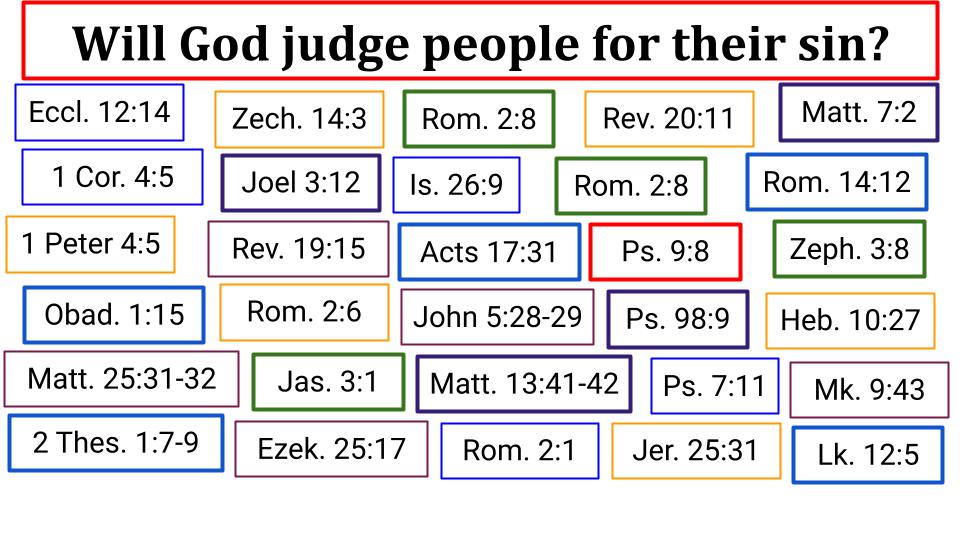
You can see in the slide above that the Bible talks a lot about judgment and these teachings run through all of Scripture from beginning to end. One of the key passages about the final judgment is in Revelation 20.
“Then I saw a great white throne and him who was seated on it. From his presence earth and sky fled away, and no place was found for them. And I saw the dead, great and small, standing before the throne, and books were opened. Then another book was opened, which is the book of life. And the dead were judged by what was written in the books, according to what they had done… And if anyone’s name was not found written in the book of life, he was thrown into the lake of fire.”
Revelation 20:11-12, 15
There are only two possible judgments people will experience that correspond with two possible outcomes.
- There is a judgment by works in which books will be opened before King Jesus and everything a person has done, said and thought will be completely evaluated by the Great Judge (Matt. 16:27). Everyone who faces this judgment will fail (Rom. 3:23) and be condemned to eternal suffering (Matt 25:46).
- The other option is to consult “the book of life.” Those who belong to Jesus (the Lamb) by faith have their names already written in His book and will not face a judgment of their works (Rom. 8:1). Instead, the Great Judge will stand beside them as their Advocate and High Priest, speaking the only words that matter in the final analysis: “This one is with me.”
“The former priests were many in number, because they were prevented by death from continuing in office, but he holds his priesthood permanently, because he continues forever. Consequently, he is able to save to the uttermost those who draw near to God through him, since he always lives to make intercession for them. For it was indeed fitting that we should have such a high priest, holy, innocent, unstained, separated from sinners, and exalted above the heavens. He has no need, like those high priests, to offer sacrifices daily, first for his own sins and then for those of the people, since he did this once for all when he offered up himself.”
Hebrews 7:23-27
Only a great fool would ignore the steady stream of warnings of judgment that God has spoken in His Word.
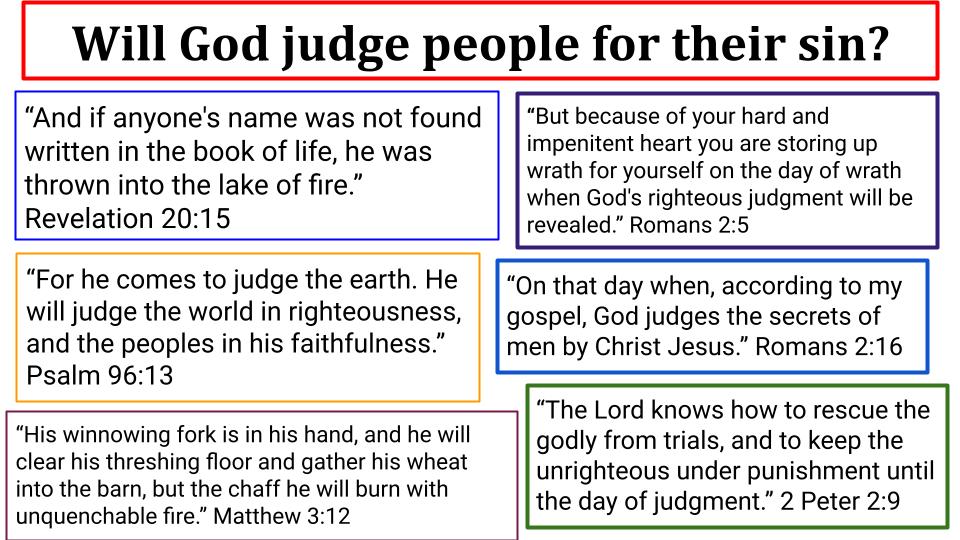
“Therefore you have no excuse, O man, every one of you who judges. For in passing judgment on another you condemn yourself, because you, the judge, practice the very same things. We know that the judgment of God rightly falls on those who practice such things. Do you suppose, O man—you who judge those who practice such things and yet do them yourself—that you will escape the judgment of God?”
Romans 2:1-3
With these words, Paul was referencing the teachings of Jesus.
“Judge not, that you be not judged. For with the judgment you pronounce you will be judged, and with the measure you use it will be measured to you.”
Matthew 7:1-2
This is terrifying if we understand what Jesus and Paul are saying. Everyone who does not call on Jesus to save them will be judged according to their own standards. Exactly the way they have judged others in life will be the measure by which they themselves will be judged.
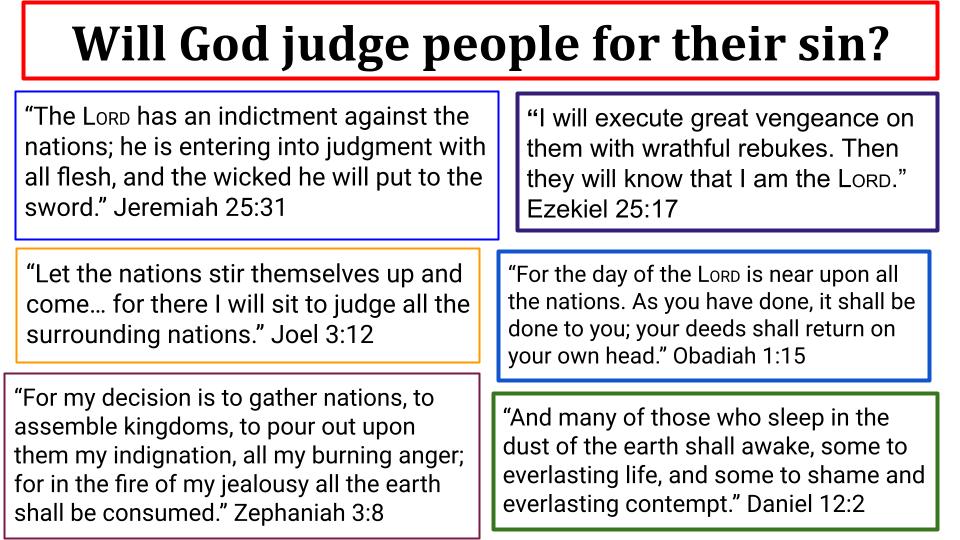
As these Scriptures make clear, the Jews clearly expected The Day of the Lord when full and final justice would be accomplished by God.
“Blow a trumpet in Zion; sound an alarm on my holy mountain! Let all the inhabitants of the land tremble, for the day of the Lord is coming; it is near, a day of darkness and gloom, a day of clouds and thick darkness! Like blackness there is spread upon the mountains a great and powerful people; their like has never been before, nor will be again after them through the years of all generations. Fire devours before them, and behind them a flame burns. The land is like the garden of Eden before them, but behind them a desolate wilderness, and nothing escapes them.”
Joel 2:1-3
But even gloomy passages like this turn toward hope and a call to repentance.
“Yet even now,” declares the Lord, “return to me with all your heart, with fasting, with weeping, and with mourning; and rend your hearts and not your garments.” Return to the Lord your God, for he is gracious and merciful, slow to anger, and abounding in steadfast love; and he relents over disaster.
Joel 2:12-13
Peter cited this promise in his gospel proclamation in Acts 2.
“The sun shall be turned to darkness, and the moon to blood, before the great and awesome day of the Lord comes. And it shall come to pass that everyone who calls on the name of the Lord shall be saved.”
Joel 2:31-31 (Acts 2:17-21)
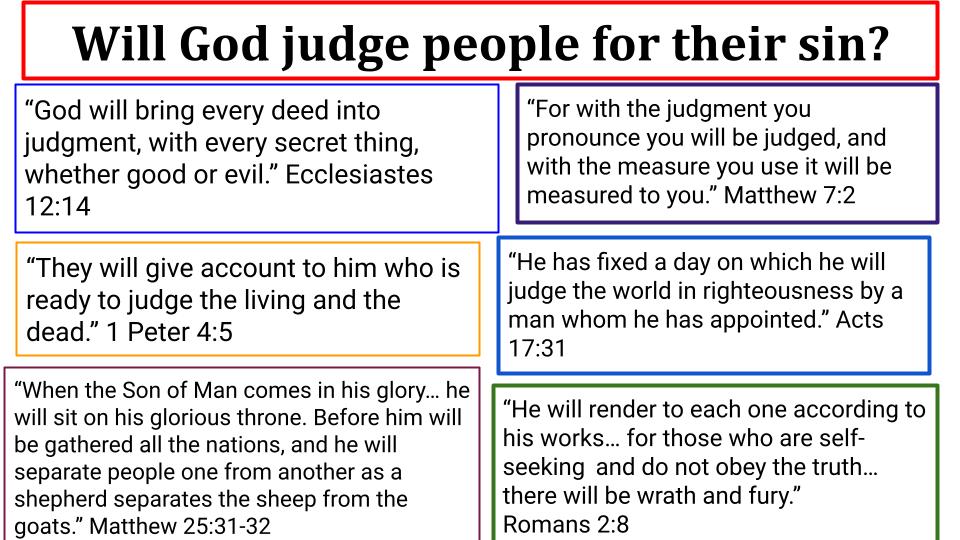
So two facts remain: 1) God will definitely judge all people and 2) there is hope for everyone who calls on Jesus to save them.
Jesus will either be a person’s Judge or their Savior. This should motivate us in at least two ways:
- To be absolutely certain that we belong to Jesus by faith (Php. 2:12; 1 John 5:12-13)
- To be bold and assertive in sharing the gospel with our friends, loved ones and neighbors while there is still time (2 Cor. 6:2; Isaiah 61:1-2)
NOW is the time of God’s favor. Soon Jesus will return and that will be the day of God’s vengeance. Final judgment is coming and books will be opened. Which side of that judgment will you be on? What about the people you care about?