
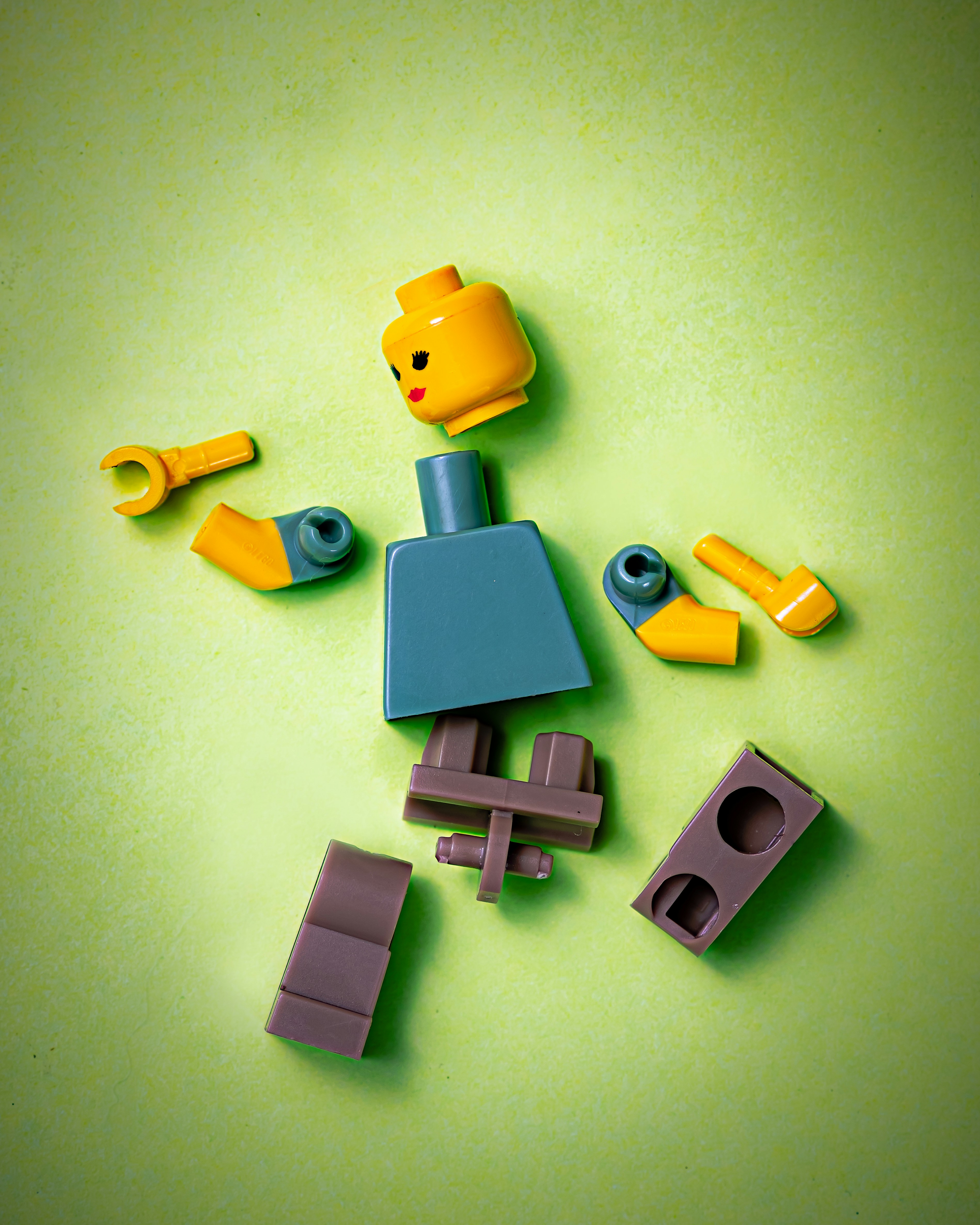
Picture a LEGO minifigure, but not the one on the shelf. This one is spread across the table: head here, torso there, one arm under the couch, legs still in the box.
Nothing is wrong with any single piece. The head is a perfectly good head. The legs are perfectly good legs. But you can’t call it a figure. It can’t stand, reach, or go anywhere.
That’s the picture Paul paints for the church in Corinth.
A body, not a collection
Paul writes in 1 Corinthians 12 that the church is one body with many parts. The eye can’t tell the hand, “I don’t need you.” The head can’t say it to the feet. Then he adds something uncomfortable: the parts that seem weaker are the ones we can least do without.
The Corinthians didn’t have a talent problem. They had gifts everywhere. What they lacked was connection. Everyone was exercising their piece, comparing their piece, and defending their piece. Paul’s response was not “get better gifts.” It was “remember you belong to each other.”
Many of us have quietly adopted a piece-by-piece version of faith. I show up, I get what I need, I go home. I serve in my corner, and I know my little team. I’m doing my part, and I assume everyone else is doing theirs.
A box of good pieces is not a body.
What makes a LEGO figure work
Look closely at a minifigure and you’ll notice something: the pieces aren’t just shaped like body parts. Each one has a connection point built into it. A stud, a clip, a socket. The design isn’t only in the piece. It’s in how the piece is made to join.
God designed His church the same way. You were not made to be complete on your own. Your gifts have sockets and your needs have studs. That’s not a flaw in the design. It is the design.
So when we talk about the life of a church, three things are really three kinds of connection points:
Connection. Do I actually know the people around me? Not their names. Their lives. A body part that isn’t attached to anything isn’t functioning, however capable it is.
Communication. Does information, need, and encouragement actually move between the parts? In a human body, a nerve that stops carrying signals means a hand that doesn’t know what the brain wants. When we don’t communicate, our people don’t know what’s happening, our leaders don’t know what’s needed, and our gifts sit unused.
Collaboration. Are we doing things together, or just near each other? Collaboration is where the hand and the eye work on the same task. It’s slower than doing it alone, and it’s how a body actually accomplishes anything.
This is a maturity issue
Here’s what often gets missed. Paul doesn’t treat this as a nice extra. In Ephesians 4, he says the goal is that we would grow up and stop being spiritual infants. Then he describes how that growth happens: the whole body, joined and held together by every supporting ligament, builds itself up in love as each part does its work.
Notice that the growth is not described as individual. You can read, pray, and study on your own, and you should. But some parts of maturity only develop in connection. Patience grows when someone irritates you. Humility grows when you need help. Generosity grows when you see a need up close. Courage grows when someone speaks truth to you, and you stay in the room.
A disconnected piece can stay a good piece forever. But it can’t grow into a body.
Where this lands for us
Healthy bodies don’t depend on a single part. If one hand holds all the coordination, all the knowledge, and all the relationships, the body is fragile, because the day that hand is gone, the rest don’t know how to move.
The goal isn’t a church that depends on a few strong pieces. It’s a church where the connections are strong enough that the whole figure stands, whoever steps in or out.
So here’s the question I’d leave with you this week:
Where are you still a piece on the table?
Maybe you’re attending but not known. Maybe you’re serving but not communicating. Maybe you’re gifted but have never really worked alongside anyone. Pick one connection point and snap it into place.
You were never meant to be a piece. You were meant to be part of a body.